


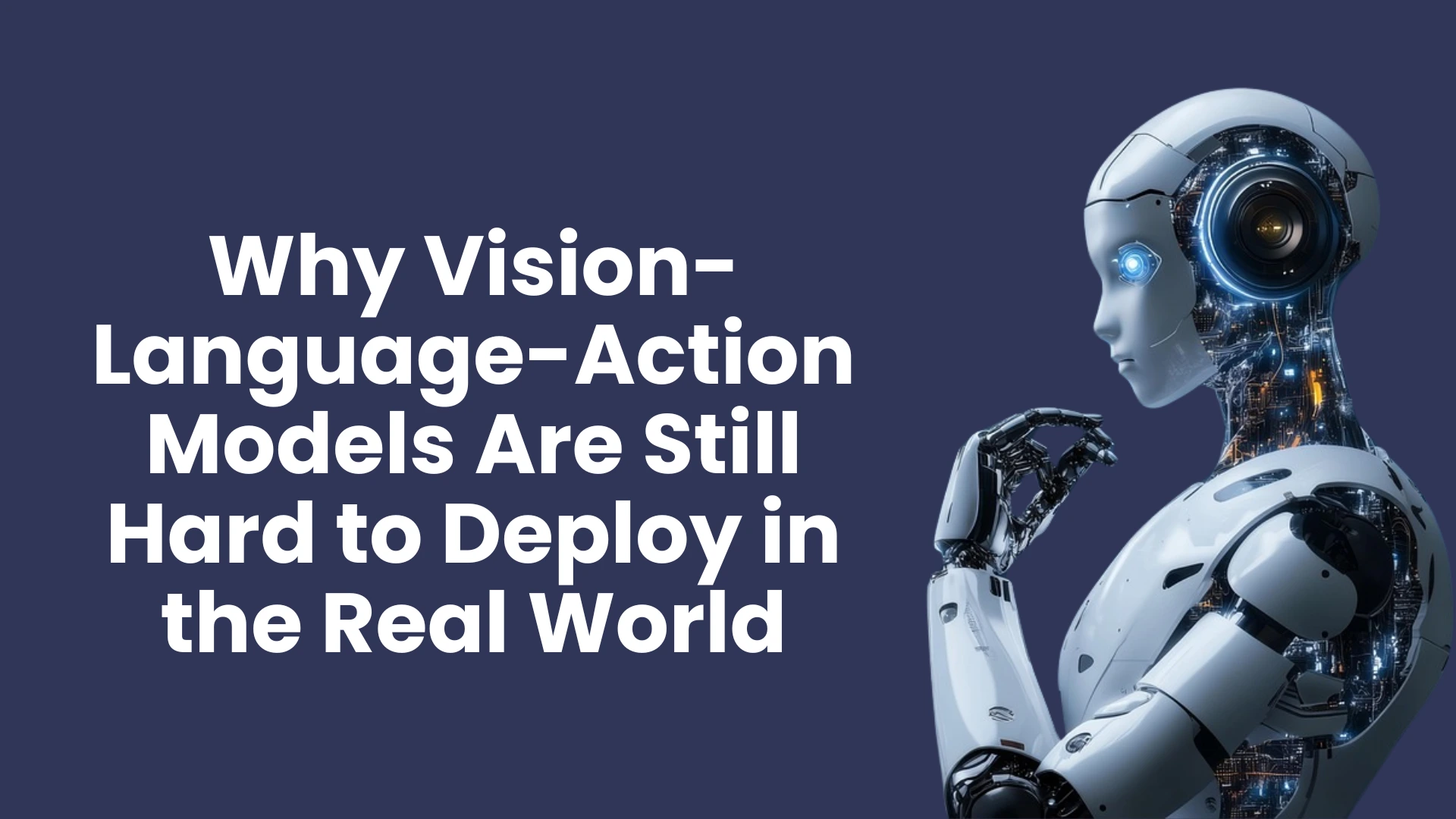
VLA models act as a bridge between a powerful vision-language model and a robot’s physical body. They connect high-level reasoning with real movement. You give instructions to these models in natural language and then they combine this information with what the robot sees through its cameras to generate the actual low-level commands and finally act on the basis of these commands. For example you ask a robot to pick up the red apple from the bowl. The robot uses this information with what it sees to form highly precise commands like the exact torque applied to each joint or the precise path a gripper must follow, calculated millisecond by millisecond. It uses these commands to perform action.
The main challenge of Vision-Language-Action Models is generalization. These models are trained in simulated environments and expected to work in real environments having real-world constraints perfectly without needing to be retrained again and again. As it’s hard to achieve this ability to work in new environments reliably without retraining, therefore for future advancement this challenge needs to be addressed urgently.
Read More: Vision-Language-Action (VLA): How Modern AI Systems Perceive, Reason, and Act
How These Models Learn to Connect Language to Movement
Before getting into the specific challenges, it is important to understand how these models actually learn to connect language to movement. Actually their primary learning method is imitation learning.
In Imitation learning (IL), the model learns by observing demonstrations, usually from a human teleoperating the robot or from a pre-existing scripted policy. The model then tries to mimic those demonstrated actions.
However, this is where one of the first major limitations appears: how robot actions are represented.
Robot actions are naturally continuous. They involve smooth movements through space. In contrast, the transformer models underlying most vision-language models are designed to work with discrete units such as words or tokens. This mismatch leads to two main approaches for representing actions.
- Discrete Action Models
- Continuous Action Models
Discrete Action Models
Discrete action models force continuous robot movements into discrete representations by quantizing actions. This means breaking down possible 3D movements into a fixed number of bins or tokens for each dimension.
With this setup, predicting an action becomes similar to predicting the next word in a sentence. For example, VLA literally adds action tokens to the language model’s vocabulary. This approach is clever because it allows researchers to directly reuse powerful pre-trained language models.
However, they have a limit. Discretizing actions leads to a loss of precision, known as lossy tokenization or quantization error. Fine details of movement are smoothed out. In addition, predicting actions token by token in an autoregressive manner is slow at around inference speeds of around 3 to 5 hertz.
At this speed, robots struggle to react quickly or handle delicate tasks. High-frequency control and fast reflexes become impractical. Even though methods like fast plus tokenization try to make action prediction faster by shortening and compressing action sequences, they are still constrained by the basic design of the model. Because the underlying architecture was not originally built for fast, continuous robot control, these techniques can only help to a limited extent.
Continuous Action Models
If discrete approaches are slow and imprecise, the alternative is continuous action models. These models aim to directly predict smooth, continuous actions using methods such as diffusion models or flow matching. Instead of tokens, they output probability distributions over a continuous action space.
This approach preserves the fluidity of movement, which is far better suited for real-world physical tasks. However, it comes with a different limit. Continuous action models significantly need much more computing power and take longer to train.
Diffusion-based policies, in particular, are especially heavy and take much longer processing time during training.
As a result, there is a clear trade-off. Discrete models are easier and faster to train but sacrifice precision and runtime speed. Continuous models produce higher-quality movements but require far more computational resources.
A Hybrid Approach
This trade-off has led to an emerging hybrid approach that aims to combine the strengths of both methods. In this setup, researchers first pre-train the main vision-language model backbone autoregressively using discrete tokens. This allows the model to develop strong general semantic understanding.
After that, a smaller and more specialized action expert module is added. This module is trained specifically to output high-fidelity continuous actions. In this way, the large model handles the what and why, while the action module focuses on the how.
To make this work effectively, techniques such as knowledge insulation are often used. These techniques protect the core knowledge of the vision-language model while fine-tuning the action component. This prevents robot-specific training from degrading the model’s broader understanding of the world.
Reasons Why Vision-Language-Action Models Are Still Hard to Deploy in the Real World
Let’s discuss the main reasons why Vision-Language-Action Models are hard to deploy in the real-world. These reasons are:
- Multimodal Sensing and Perception
- Robust reasoning gaps
- Quality of Training Data
- Crossroot Action Generalization
- Resource efficiency
- Whole Body Coordination
- Safety assurances
- Human robot coordination
Multimodal Sensing and Perception
The first challenge is multimodal sensing and perception because robots need accurate understanding of the physical world to act correctly, and current perception systems do not provide that level of understanding.
Most current Vision-Action Systems are using standard RGB cameras, which only provide color images and color video feeds, and that is a huge limitation. If depth information, or proper 3D sensing, is not explicitly incorporated, the robot only guesses about size and distance. It sees the world flat. The system may know what an object is, but it does not really understand where it is in 3D space or how big it is.
This lack of spatial awareness leads to clumsy interactions and reasoning errors. Some models try to infer depth from 2D images, but this is not the same as having direct measurement. That is why there is a strong push to integrate more senses.
The challenge becomes more serious when tasks require senses beyond vision such as audio, touch or force feedback. It becomes even more important in scenarios like search and rescue where listening for survivors matters.
An even more critical challenge is touch and force feedback. Delicate tasks such as assembling electronics or handling glassware are not possible without knowing how hard the robot is pressing. Touch improves performance because the robot needs to feel what it is doing.
Robust Reasoning Gaps
The other challenge is reasoning gaps even when powerful language models are used.
It is thought that these super smart models would ace simple robot tasks like picking up a block and putting it down. But that high intelligence doesn’t always translate smoothly into low-level physical execution
One major issue is the need for near-perfect reliability. An LLM making a small factual error might be acceptable in text-based systems but unacceptable in robotics. For example, a robot dropping a critical component or worse bumping into a person is unacceptable. Error rates for basic physical tasks need to be practically zero for real-world deployment. And this gets much worse for longer, more complex tasks.
Quality of Training Data
Scaling, generalization, and efficiency are another major set of challenges. Even though we have massive data sets now like OpenX embodiment with over a million demonstrations. Yet the models are still brittle. Throwing more data at it isn’t working
It’s not just about volume. It’s about diversity, quality, and the infamous SIM 2 real gap. Human collected data, while valuable, is often noisy, inconsistent, and doesn’t cover every possible scenario.
And simulation data, while cheap and plentiful, often fails to capture the subtle physics of the real world like friction, reflections, tiny variations in robot joint stiffness, etc.. These details matter immensely. A policy trained purely in simulation often just falls apart when run on a real robot.
Crossroot action generalization
Cross-robot action generalization is another major challenge. Suppose you train a model on one specific robot arm. When you apply it to a different robot’s arm it fails, even one that looks similar. The problem becomes even more severe when moving across entirely different robot types, such as from an arm to a legged robot.
This problem is due to action heterogeneity. Each robot has a different body, different joints, different sensors, and control mechanisms. The policy learned is deeply tied to the specific embodiment it was trained on.
So it’s like learning to drive a specific car model and then expecting to perfectly drive a truck or a motorcycle immediately. Although the core concepts are the same, the controls and dynamics are totally different.
Solving cross-robot action generalization is essential for building truly general-purpose robot models that don’t need retraining for every single piece of hardware.
Resource efficiency
Resource efficiency is another key challenge for Vision-Action models. These models can be huge, needing massive computing power for training. But robots in the field have limited onboard computational resources. They don’t have racks of GPUs on board. Relying on cloud servers to run the model introduces latency and dependency on network connectivity.
Imagine a rescue robot in a collapsed building losing Wi-Fi. If it needs the cloud for every decision, it becomes useless. So finding that balance between model capability and on device efficiency is critical for practical deployment.
Whole Body Coordination
Whole body coordination is a prominent challenge especially in robots that move around and manipulate objects.
A mobile manipulator needs to coordinate its base movement, the locomotion, with its arm movement, the manipulation. They have to work together seamlessly.
There are two main ways to do this currently.
- Model-based control
- learning based control
Model-based control like MPC which uses physics-based models to plan precise movements. It’s accurate but computationally heavy and relies on accurate models of both the robot and the environment which is hard in messy real world settings.
Learning based control which is more adaptable but often struggles with generalization and doesn’t provide strong safety guarantees. Because of these limitations, a hybrid approach is a promising way to achieve full-body coordination. It combines learning-based methods for high-level guidance with model-based techniques to ensure safety and precision.
Safety assurances
Safety assurance feels like a much bigger concern when the AI systems are able to physically interact with the world.
It’s arguably the highest stakes challenge. Unlike an LLM generating harmful text, an embodied AI can cause direct physical harm unintentionally or or through incorrect actions.
The standard safety alignment techniques used for LLMs aren’t sufficient for embodied systems. Robots need robust guardrails built into the action generation process itself.
To address this, researchers are exploring how to use reinforcement learning specifically to learn safety constraints to prevent the robot from even considering an unsafe action ideally without crippling its ability to perform the task.
Agentic frameworks and multi-root collaboration
Agentic frameworks is an important area of development for Vision-Action models. It is about multiple robots working together as a coordinated system.
Precisely. It’s about multi-root collaboration. It’s like a team of robots sharing sensor information. One robot gets a view from one angle, another sees it differently, and they combine that information. Or they could delegate tasks or even offload computation to each other with greater processing capacity.
It’s a way to overcome individual limitations like resource constraints or limited perception by working as a team. Although this is still a relatively new area in Vision-Action Systems, it is very promising.
Human robot coordination
Human–robot coordination is another key challenge. Current interaction is mostly one way, where humans tell robots what to do. This limited form of interaction is not sufficient for complex or real-world tasks. We need a proper dialogue. The robot needs to be able to communicate back effectively rather than just executing commands. But they must explain why they are doing something or asking for clarification if an instruction is ambiguous.
Some models like Cottovla or Emma X generate rationale or even show a preview of the intended outcome before acting. This kind of transparency is key for building trust and enabling more complex collaboration between humans and robots.
FAQs about Why Vision-Language-Action Models Are Still Hard to Deploy in the Real World
1. Why is generalization such a big problem for Vision-Language-Action models?
The main challenge of VLMs is generalization. These models are trained in simulated environments and expected to work in real environments having real-world constraints perfectly without needing to be retrained again and again. As it’s hard to achieve this ability to work in new environments reliably without retraining, therefore for future advancement this challenge needs to be addressed urgently
2. Why don’t large datasets solve the problem for VLA models?
It’s not just about volume. It’s about diversity, quality, and the gap between simulation and the real world.. Human collected data, while valuable, is often noisy, inconsistent, and doesn’t cover every possible scenario. And simulation data, while cheap and plentiful, often fails to capture the subtle physics of the real world like friction, reflections, tiny variations in robot joint stiffness, etc.. These details matter immensely. Because of this, models trained on large datasets still struggle in real environments.
3. What is the difference between discrete and continuous action models?
Discrete action models break robot movements into fixed tokens, similar to words in a language model. They are easier to train but lose movement precision and are slow at runtime. Continuous action models predict smooth movements directly, which is better for physical tasks, but they require much more computation and longer training times.
4. Why is safety such a critical challenge for VLA models?
Safety is arguably the highest stakes challenge. This is because unlike an LLM generating harmful text, an embodied AI can cause direct physical harm unintentionally or through incorrect actions. The standard safety alignment techniques used for LLMs aren’t sufficient for embodied systems. Robots need robust guardrails built into the action generation process itself.
5. Why is human-robot coordination still difficult?
Human–robot coordination is another key challenge due to which Vision-Language-Action Models are still hard to deploy in the real world. One way interaction is not sufficient for complex or real-world tasks. We need a proper dialogue. The robot needs to be able to communicate back effectively rather than just executing commands. But they must explain why they are doing something or asking for clarification if an instruction is ambiguous. Without this two-way interaction and transparency, it is hard to build trust and enable effective collaboration between humans and robots.