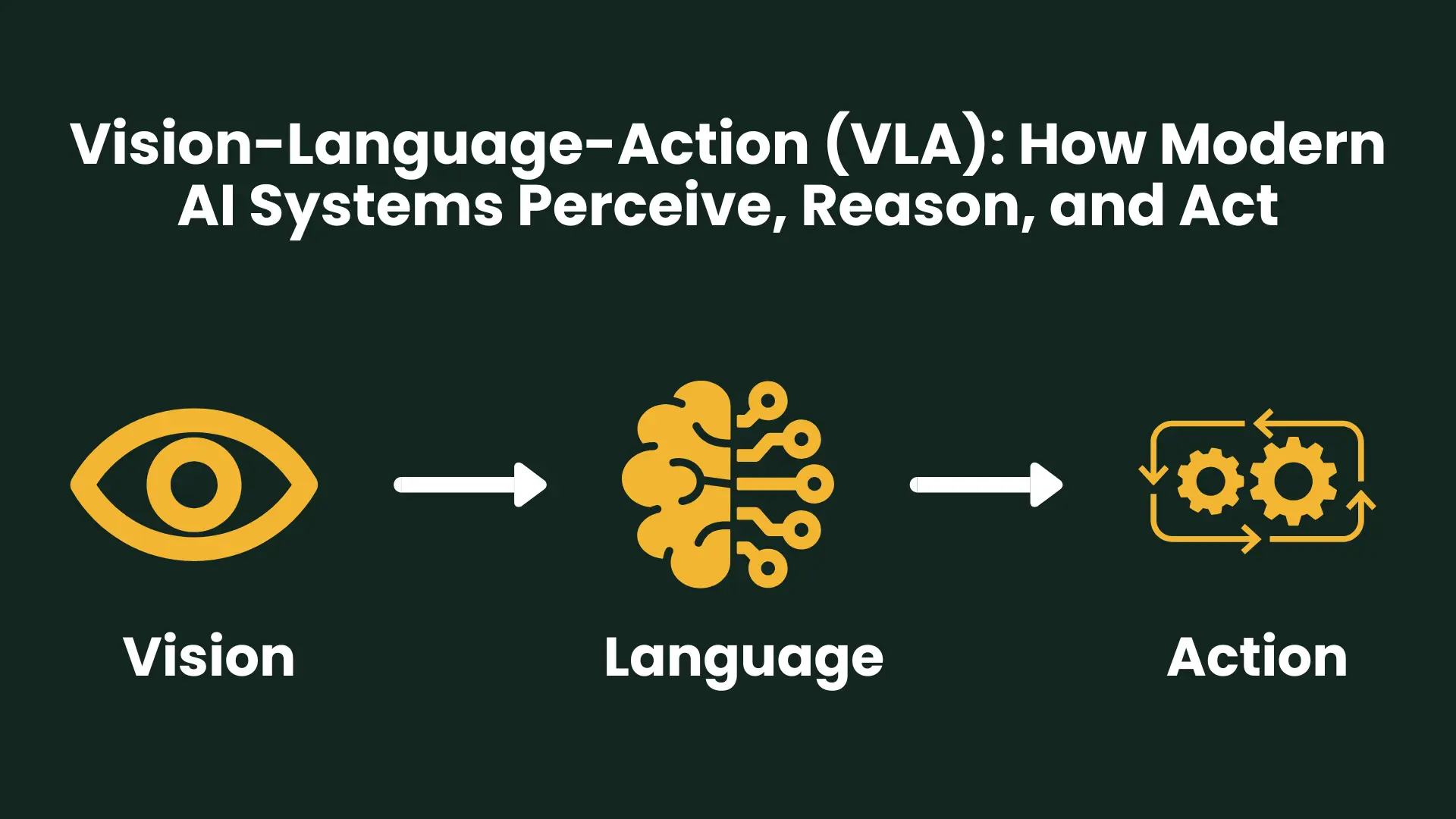
Vision-Language-Action models are designed to connect perception, reasoning, and execution into a single system. They aim to move beyond task-specific robotic programs toward more general and adaptable policies. A core objective of VLA systems is to enable a single policy to control different robots, perform multiple tasks, follow instructions expressed in non-coding language, and adapt to new environments, tasks, and robotic embodiments.
The long-term goal of Vision-Language-Action models is often compared to the capabilities of large language models such as ChatGPT. In the same way that language models can answer a wide range of questions from natural language input; although, sometimes imperfectly, but with broad generalization. Similarly, VLA systems seek to bring a similar level of flexibility and generalization to robotics. While current VLA systems do not yet fully achieve this level of autonomy, they represent a significant step toward that direction.
Vision-Language-Action models are closely related to large language models at an architectural level. VLAs can be understood as adaptations of LLMs that are extended to handle multimodal inputs and produce actions instead of only text. Because of this shared foundation, many of the advances in large language models directly influence the development and progress of Vision-Language-Action systems.
Explore more about: What Is AI System Architecture and How Does It Work?
Why Are Traditional AI Systems Not Enough for Real-World Tasks?
Traditionally, robots are based on task-specific programs. They are programmed to perform only a single task within fixed conditions using predefined rules. These robots work well under controlled conditions but if the environment changes a bit they struggle to perform action.
In the real-world, the environment and conditions never remain the same. At the same time, users expect robots to handle variation and uncertainty. But task-specific robots don’t adapt to these changes and require manual reprogramming and retraining to sustain in a changed environment or perform unfamiliar tasks.
Moreover, traditional robotic policies lack generalization. They are rigid and rule based that train the robots under defined conditions. So every time, when there is a need to scale a robotic system, it costs a lot and takes a great amount of time because each new task requires a separate development cycle.
Now, expectations tied to robotics are changing and resemble the flexibility seen in large language models. As these models can respond in many languages, on any topic to a variety of prompts without being trained for each question, people want robots to be that flexible with respect to tasks they perform and environment they can adapt to.
This gap between rigid task-based robotics and the need for adaptable, instruction-driven systems is one of the primary motivations behind Vision-Language-Action models. VLA systems are designed to overcome these limitations by combining perception, reasoning, and action within a single, general-purpose policy rather than relying on narrowly defined robotic programs.
From LLMs to VLMs to Vision-Language-Action (VLA) Systems
Vision-Language-Action (VLA) systems are highly evolved forms of large language models.
Their evolution process is:
LLMs → VLMs → VLAs
Large language models are designed to accept prompts in the form of text in natural language and predict the next token that is also in the form of text. Their core function is next-token prediction, repeated autoregressively. They have capability to respond in coherent language to written prompts without being trained for each of the prompt or user query.
As these models evolved, visual understanding was added. By incorporating vision into language modeling, Vision-Language Models (VLMs) were developed.
VLMs can accept both text and image as an input and predict the next token in the form of text and sometimes image too but through separately connected components. Most modern AI systems, like Chatgpt, Gemini, etc. are already vision-language models that can process images in parallel to texts.
To enable physical interaction, models must go beyond perception and language understanding. This leads to Vision-Language-Action (VLA) models. A Vision-Language-Action system accepts text, images, and the state of a robot as input and predicts robot actions as output. By adding action prediction to vision-language understanding, VLAs extend language-based models into the domain of robotics and real-world control.
Although the naming differs, LLMs, VLMs, and VLAs are closely related in practice. The core of all these models is the same transformer-based architecture. Vision and action capabilities are added around this shared foundation, but the underlying language model remains largely the same. Because of this, Vision-Language-Action systems can be seen as extensions of language models that are adapted to perceive environments and generate actions instead of text alone.
How Does the Architecture of Vision-Language-Action (VLA) Systems Work?
The architecture of Vision-Language-Action (VLA) systems is built step by step on top of modern language models. At its core, a VLA system extends the same underlying structure used in large language models so that it can understand the world and take actions, not just generate text.
Language Model as the Core Reasoning Engine
At the heart of a VLA system is a transformer-based language model. This model consists of many stacked transformer decoder layers. Its primary function is to process text tokens and build a contextual understanding of them. After passing input tokens through multiple layers, the model predicts the next token in a sequence. This process is repeated autoregressively, which is how language models generate complete outputs.
In VLA systems, this language model still performs the main “thinking.” It interprets instructions, understands context, and forms high-level decisions based on the input it receives.
Adding Vision Through a Visual Backbone
To enable perception, a visual backbone is attached to the language model. The visual backbone is a neural network that takes images as input and converts them into numerical representations. Earlier systems often used convolutional neural networks, while newer designs frequently rely on transformer-based vision encoders.
Both the language model and the visual backbone are usually pre-trained on large-scale datasets. Language models are trained on massive amounts of text, while vision models are trained on large image datasets. The outputs of the visual backbone are then connected to the input of the language model, allowing the system to reason jointly over text and visual information. When trained further on multimodal tasks, this combined system becomes a vision-language model.
Extending Vision-Language Models to Actions
To move from vision-language models to Vision-Language-Action systems, the model must gain the ability to predict actions. This requires adding an action-generation mechanism on top of the shared language model backbone.
One approach is to allow the language model itself to predict action tokens. In this design, the token vocabulary is extended so that some tokens represent robot actions rather than words. Continuous robot actions are converted into discrete tokens through compression or clustering. The language model is then trained on robot datasets so it learns to produce these action tokens directly.
Another widely used approach is to add a separate action head, sometimes called an action expert. This module receives the internal representations produced by the language model and converts them into continuous robot actions. Many VLA models use diffusion-based transformers for this purpose. Instead of predicting actions directly, the action head gradually transforms noise into realistic action trajectories. This transformation is guided by the output of the language model, which provides high-level reasoning and intent.
Why Most VLA Architectures Look Similar
Although individual VLA models may differ in details, their overall structure is very similar. Most systems combine:
- A transformer-based language model for reasoning
- A visual backbone for perception
- An action-generation mechanism for execution
Different models may choose different language models, visual encoders, or action generation methods. Some inject robot state information into the language model, while others pass it directly to the action head. Some models use action tokens, others use diffusion, and some combine multiple techniques. Despite these variations, the core architecture remains the same.
Why This Architecture Enables Generalization
The key advantage of VLA architecture is that it starts from models already pre-trained on large amounts of text and images. This means a great deal of knowledge about the world is already embedded in the model’s parameters. When adapted for robotics, the system does not learn from scratch. Instead, it builds on existing representations, which enables better generalization across tasks, environments, and instructions expressed in natural language.
How Are Vision-Language-Action Models Trained and Fine-Tuned?
Policy training in robotics is the process of teaching a robot how to choose actions based on observations by learning from data. There are many important factors that tell how effective the robotic policy is. These factors are:
- success rate across different tasks
- What type of tasks can it complete?
- What is the duration of these tasks?
- What is dexterity?
- What is the multimodality level that present in these tasks and so on so forth
These metrics are gradually improving as new policies and training approaches developed.
Beyond performance metrics, Vision-Language-Action systems have fundamentally changed how robotic policies are trained and used. VLAs introduced fine-tuning as a core training approach in robotics, similar to the shift that occurred in natural language processing over the past decade. Instead of training robots from scratch for every new task, modern robotic systems are now fine-tuned from pre-trained models.
Traditional Non–End-to-End Policies
Historically, most robotics systems relied on non–end-to-end policies. In this approach, engineers separately develop perception, planning and control components of robotic policy and then combine them into one pipeline. This pipeline usually has a lot of manual corrections and deterministic, non-trainable logic.
Industrial and warehouse robotics rely on this design because their environment is reliable and predictable. Moreover, robots deployed in production lines also use this classical approach rather than learning-based policies. Open-source ecosystems such as ROS 2 provide modular tools and algorithms that support this traditional approach.
End-to-End Policy Training
The introduction of neural networks brought the idea of training end to end policies. An end-to-end training policy is a single learned model that maps raw inputs directly to actions without separating perception, planning, and control.
In this policy, robots are trained using task-specific datasets. For example, if you have to train the robot to pick up the cup, you have to provide it data accordingly and train it how to perform its task systemically.
But the robot is modeled to perform a specific task under a specific environment. For example, if you train your robot to pick the cup from the table, it will do it until the dynamics like environment and task remain the same. If you change a task or environment , the robot fails to perform its task and you have to train it from scratch to perform an unfamiliar task under an unfamiliar environment. Policies such as ACT and diffusion-based models follow this pattern.
End-to-end policies reduce manual engineering but are still largely task- and robot-specific. Each new task or robot configuration typically requires collecting new data and retraining the model from scratch.
Fine-Tuning as a Core VLA Training Pattern
In VLA systems, robots are not trained from point zero every time, rather training is done in two steps. In the first step, an AI model is trained on many different tasks, environments, and situations. This initial training allows the model to learn general skills, like understanding instructions, recognizing patterns, and making decisions.
The second step involves fine tuning. This is performed when a robot needs to do a specific task. The already trained model is trained a little more using a small amount of new data related to that task. Initially, the model has general knowledge but in this step it is specially trained on task-specific dataset. Because the model already knows many general things, this second step takes less time, needs less data and helps the robot adapt better to new tasks
Even though it is harder to measure progress in robotics due to differences in robots and environments, fine-tuning is widely considered a better way to train robotic policies because it improves performance and flexibility.
Fine-Tuning for the Robot
A further extension of this idea is fine-tuning for the robot rather than the task. In this pattern, the goal is not to train a policy for a specific task, but to train a policy to control a particular robot across many different tasks.
Instead of training a model to do one task, the model is trained to control the robot itself. This means the robot learns how its arms, joints, and movements work across many different tasks, not just one. Because of this, the robot is expected to reuse what it learned before, handle new tasks more easily, and adapt without being retrained again and again
Some advanced research labs have shown early examples of this working. These systems can handle new tasks and environments better than task-specific models. However, this approach is still mostly found in research demos and is not yet common or easily available in open-source tools.
Plug-and-Play Policies
The long-term goal of Vision-Language-Action (VLA) training is to make robots work like plug-and-play devices.
This means a robot could use a pre-trained model and start working as a new robot it has never seen before. Instead of long training, it would only need:
This level of control does not exist yet. However, early research experiments show that it might become possible as AI models get bigger and are trained on more data.
Instead of learning a single task in isolation, VLA-based policies are designed to reuse knowledge across tasks, robots, and environments through fine-tuning. This marks a clear shift from task-specific learning toward reusable and adaptable robotic intelligence.
FAQs about Vision-Language-Action
What does Vision-Language-Action (VLA) mean?
Vision-Language-Action models are designed to connect perception, reasoning, and execution into a single system. They aim to move beyond task-specific robotic programs toward more general and adaptable policies. A core objective of VLA systems is to enable a single policy to control different robots, perform multiple tasks, follow instructions expressed in non-coding language, and adapt to new environments, tasks, and robotic embodiments.
Are VLAs basically LLMs for robots?
Vision-Language-Action models are closely related to large language models at an architectural level. VLAs can be understood as adaptations of LLMs that are extended to handle multimodal inputs and produce actions instead of only text. Because of this shared foundation, many of the advances in large language models directly influence the development and progress of Vision-Language-Action systems.
How is VLA different from a vision-language model (VLM)?
VLMs can accept both text and image as an input and predict the next token in the form of text and sometimes image too but through separately connected components. Most modern AI systems, like Chatgpt, Gemini, etc are already vision-language models that can process images in parallel to texts. Whereas, a Vision-Language-Action system accepts text, images, and the state of a robot as input and predicts robot actions as output.
What are the two main ways VLAs predict actions?
VLAs typically predict actions in two ways:
- Action tokens inside the language model
The language model is extended so some of its outputs represent robot actions instead of words. - Separate action head (or action expert)
A dedicated module converts the model’s reasoning into continuous robot movements, often using diffusion-based methods.
Both approaches rely on the same language model for decision-making.